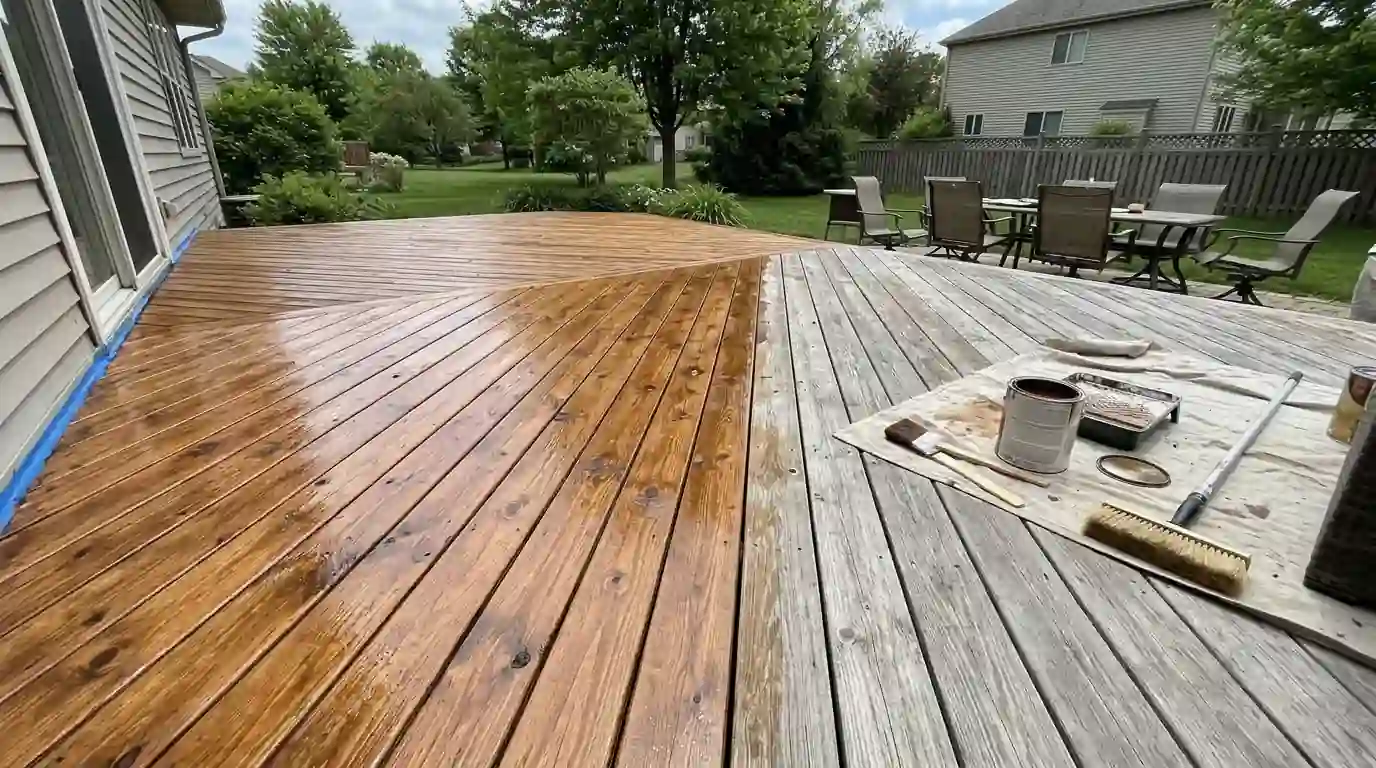
Short answer
Deck restoration in Naperville means taking a failed coating down to bare wood before new stain goes on, because fresh stain brushed over peeling stain lifts with it. HomeAdvisor's published range for refinishing runs $3 to $7 per square foot, or $900 to $2,720 for a 200 square foot deck.
Why a peeling deck needs stripping, not another coat
Solid stains and deck paints sit on top of the wood as a film. Once water gets under that film it lifts in flakes, and anything brushed over it lets go with the old layer.
Restoration takes the deck back to wood that can drink in stain again. Stripper, brightener and sanding do most of the work, and repairs happen while the boards are bare and easy to inspect.
Published deck refinishing ranges
These are HomeAdvisor's published planning ranges for deck refinishing, not our quote, and the walk-through sets your number.
| Job | Typical range | Unit | Source |
|---|---|---|---|
| Deck refinishing (200 sq ft deck) | $900 to $2,720 | total (normal range) | HomeAdvisor |
| Deck refinishing | $3 to $7 | per sq ft | HomeAdvisor |
What moves the price
- Deck size, levels and stair count
- Which coating is coming off, and how many layers
- Rails, spindles and lattice to strip
- Boards and fasteners to replace
- Solid versus semi-transparent stain afterward
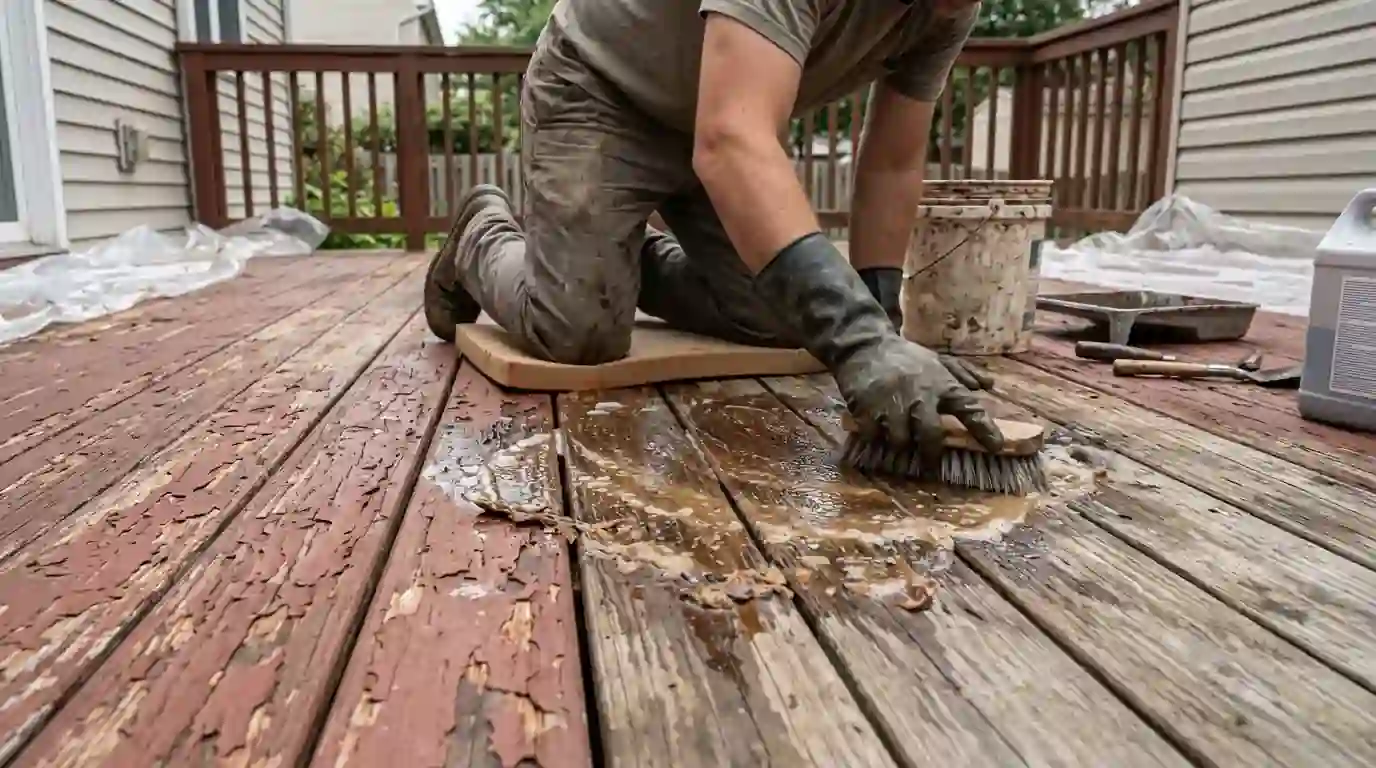
Stripping failed stain
Film-forming finishes fail by peeling, which leaves a patchwork of coated and bare wood that no new product can even out. We wet the deck, apply a stripper suited to the coating that is on it, give it time to soften the old film and scrub it loose with stiff brushes. A low-pressure rinse carries the residue away without tearing the grain. Rails, stair stringers and post caps are stripped too, so the whole deck starts from the same bare surface.
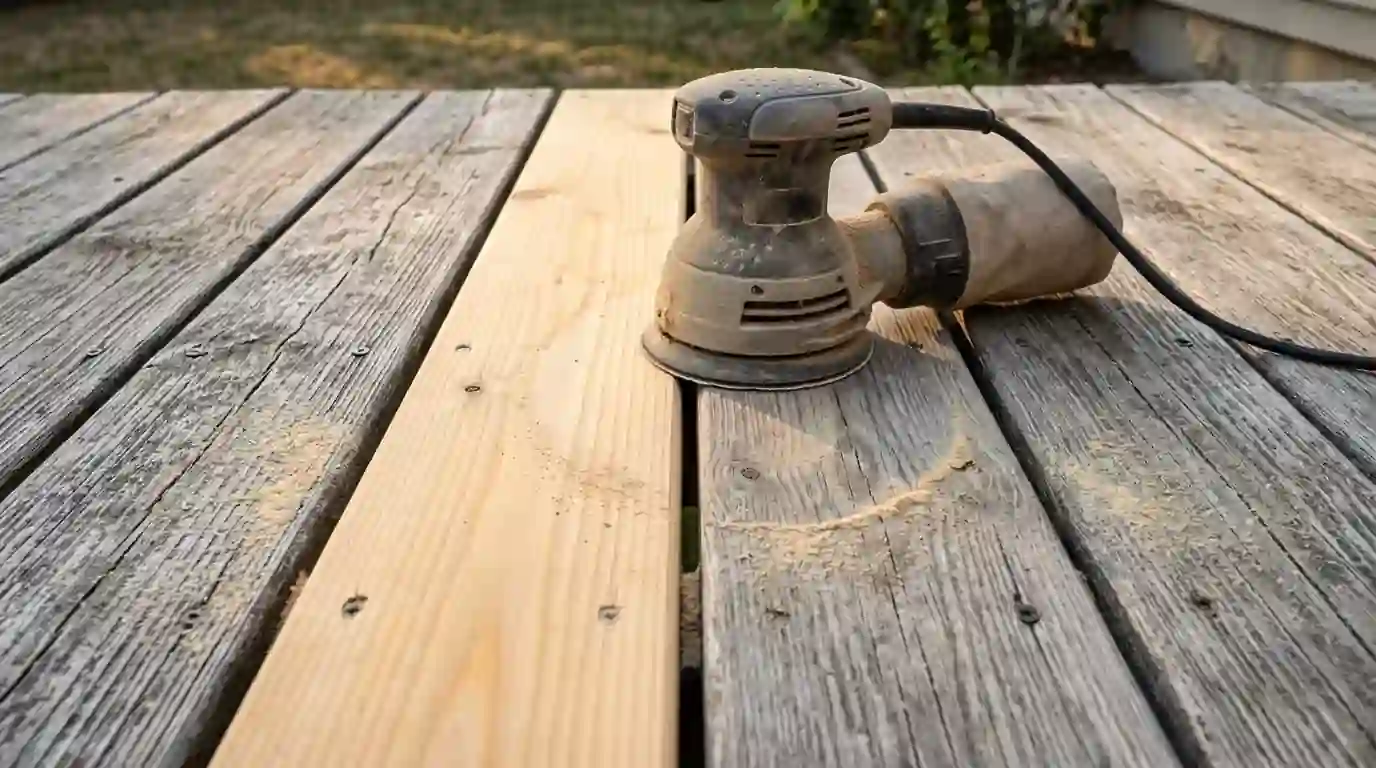
Sanding and brightening
Stripper leaves wood dark and slightly caustic, and surface fibers stand up as the boards dry. A brightener, usually oxalic acid based, neutralizes the stripper, lifts tannin and gray weathering stains and brings the color back toward fresh lumber. Once the deck is fully dry, we sand the walking surface to knock down raised grain and splinters, with extra attention on stair treads and the path from the door. Sanding with too fine a grit can close the pores and keep stain out, so the grit is matched to the finish going on.
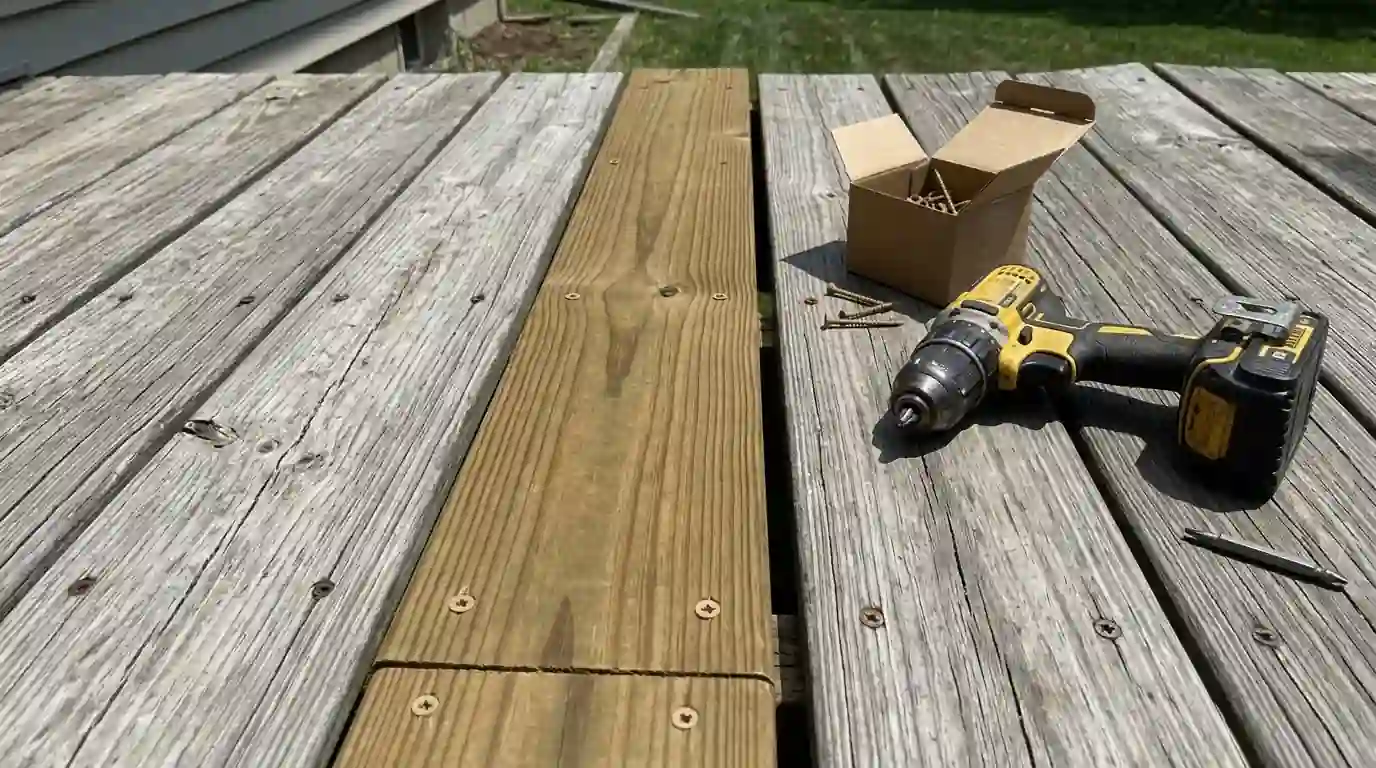
Loose and split boards
A bare deck shows every problem the old coating hid: popped nails, cupped boards, split ends and soft spots near the house or under planters. We drive or replace popped fasteners, swap boards that are cracked through or spongy, and flag anything structural, such as soft joists or a loose ledger board, so it is repaired before staining goes ahead. New boards will not match weathered ones at first, so a semi-solid or solid stain often suits a repaired deck better than a clear finish. We talk that through before you choose a color.
What a deck restoration includes
On our restoration jobs, unless the walk-through says otherwise, the scope covers:
- Covering plants, siding and doors near the deck
- Stripping the floor, rails and stair parts
- Brightener to neutralize stripper and even the color
- Refastening popped nails and screws
- Sanding raised grain on walking surfaces
- Rinsing off and hauling away the residue
Stripping season in Stillwater and the rest of Naperville
Strip days follow the overnight lows. At O'Hare the average low reaches 40.3°F in April, holds above 40°F all the way to October's 45.4°F, and drops to 34.1°F by November. That gives us spring through early fall for stripping, with a dry spell built in between the rinse and the stain. In Stillwater, near Springbrook Prairie, a deck stripped in late spring is ready for summer, while one started in late October risks cold nights before the stain sets.
From peeling deck to fresh stain in five steps
- Assess. Test how the old coating comes off and mark failing boards.
- Strip. Stripper applied, scrubbed in and rinsed off at low pressure.
- Brighten and repair. Brightener neutralizes the wood while loose and split boards get fixed.
- Dry and sand. Boards dry fully, then raised grain and splinters are sanded down.
- Stain. New stain goes on in the right weather, rails before floor boards.
Signs your deck needs stripping before stain
- Peeling in sheetsOld solid stain or paint lifts in flakes along board edges and walkways.
- Patchy colorWorn traffic lanes look bare while corners and spots under chairs still hold coating.
- Mixed water testWater beads on some boards and soaks into others, so coverage is uneven.
- Gray, furry woodWeathered fibers rub off on your hand and splinters catch bare feet.
- Mildew under the filmDark blotches under the old finish come back after every simple wash.
Stains that suit a freshly stripped deck
After stripping, we usually reach for Cabot, Sikkens or Ready Seal penetrating stains, and Duckback where a deck needs a solid color to even out new boards.
- Sherwin-Williams
- Benjamin Moore
- PPG Paints
- Behr
- Valspar
- Cabot
- Sikkens
- Olympic
- Zinsser
- Kilz
- Romabio
- Ready Seal
Jobs that often go with this one
Deck Staining
Washed, dried and stained
Pressure Washing & Soft Washing
Siding, decks and flatwork
Fence & Pergola Staining
Fences, pergolas and gazebos
Wood Rot Repair Before Painting
Sills, fascia and jambs fixed first