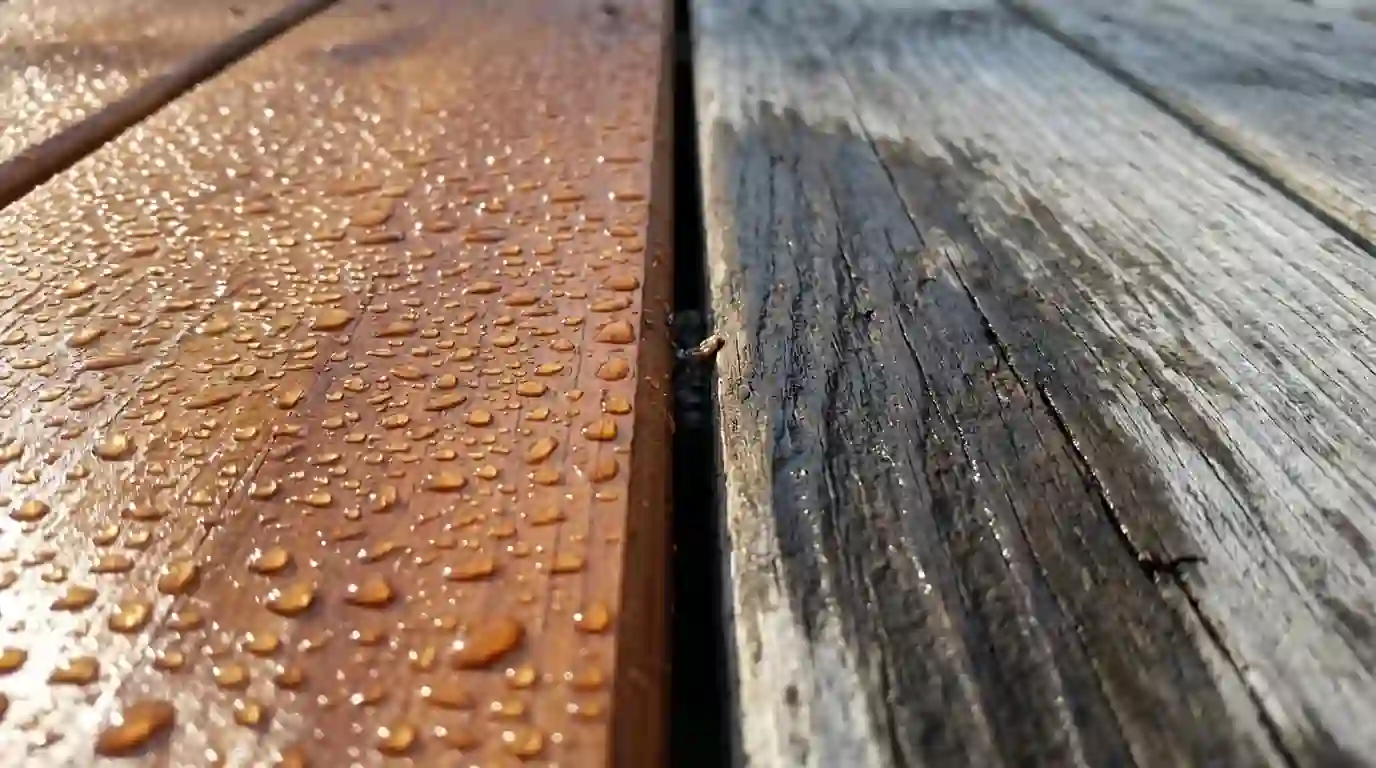
Short answer
Restain when a splash of water soaks into the boards instead of beading, which usually shows on the floor before the rails. Plan the work for a dry, mild stretch: Cabot recommends staining between 50°F and 80°F with no rain expected for 24 hours. HomeAdvisor puts a normal deck staining job at $550 to $1,250.
The spring water test that sets your schedule
Once the deck is dry, pour a cup of water on the busiest boards near the door and on a rail. If the water beads and sits, the stain is still working. If it darkens the board and soaks in within a minute or so, the wood is open to moisture. That is your signal to plan a coat.
Repeat the test every spring. Do it again in late summer if the deck faces south or west. Walk the deck barefoot, too: raised grain and splinters mean the surface has weathered past the stain. Graying wood is the clearest visual sign, since sunlight breaks down the surface fibers once the stain is gone.
Keep a simple log: the date of each coat, the product and color, and the date the water test first failed. After two or three cycles you will know your own deck's rhythm. It depends on sun, wood type and how hard the deck gets used. The record also helps any painter match the product next time.
Why the floor wears out before the rails
Horizontal boards take the worst of everything. Sun hits them square and melting snow sits on them. Shoes, chairs, grills and shovels grind at the finish. O'Hare averages 38.4 inches of snow a winter, and a deck buried under snow for weeks stays wet far longer than a vertical rail ever does.
That is why a floor-only coat between full jobs is a sensible middle step. Rails, spindles and fascia boards hold stain longer, so they can often skip a round. Splitting the work this way keeps the color even when the same product is used. It also saves time on the slowest part of any deck job: brushing every spindle.
Shovels and ice melt deserve a mention. A metal shovel scrapes the stain off every board it touches, and some de-icing products are hard on wood and fasteners. A plastic shovel, a broom for light snow and a check of the ice melt label help a winter pass with less damage to the floor.
Stain type changes how often you are back
Clear sealers and light toners show the most wood and wear the fastest, because they carry little pigment to block sunlight. Semi-transparent stains carry more pigment, protect better and still show grain, which is why they are the usual choice for cedar and pressure-treated decks. Solid stains look like thin paint and last longest on vertical parts.
The trade-off with solid stain shows up on the floor. It forms a film, and when that film fails under foot traffic it peels, which means stripping or heavy sanding before the next coat. Switching from a solid back to a semi-transparent also requires stripping to bare wood, so choose the stain type for the long run. Our deck staining page explains how each product goes on.
Wood species shifts the schedule as well. Cedar has natural oils and tannins that resist decay but can bleed through light stains, so it is usually cleaned and brightened before coating. Pressure-treated pine is dense and wet when new and takes stain unevenly until it has dried out. Both do best with thin coats that soak in rather than a thick layer that sits on top.
A recoat or a full strip: how to tell
If the old stain has simply faded and the water test fails, a wash and a fresh coat of the same product is usually enough. If the old coating is peeling, blotchy or a patchwork of products from different years, it has to come off. Stripping, sanding and brightening take the deck back to clean wood. Then new stain can soak in evenly.
Loose or split boards and popped fasteners get fixed first either way. Stripping is real work, and it shows in the published figures: HomeAdvisor lists deck refinishing at $900 to $2,720 for a 200 sq ft deck, or $3 to $7 per square foot, against $1 to $4 per square foot for a straight staining job. See stripping a failed deck finish for how that work runs.
| Job | Published range | Unit | Source |
|---|---|---|---|
| Deck staining | $550 to $1,250 | Normal total | HomeAdvisor |
| Deck staining | $1 to $4 | Per sq ft | HomeAdvisor |
| Deck refinishing, 200 sq ft deck | $900 to $2,720 | Normal total | HomeAdvisor |
| Deck refinishing | $3 to $7 | Per sq ft | HomeAdvisor |
| Deck or patio washing | $100 to $200 | Total | Angi |
| Fence painting or staining | $3 to $14 | Per linear ft | HomeAdvisor |
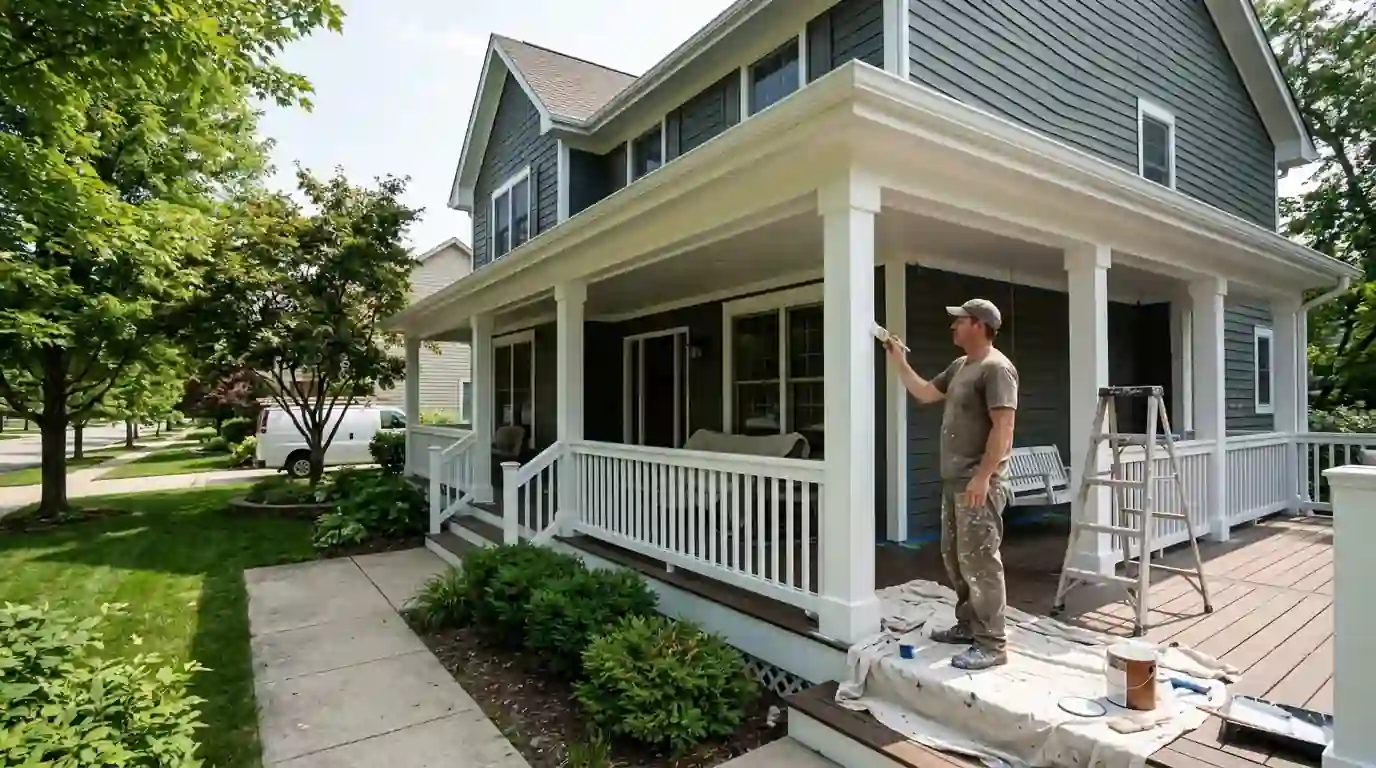
Call any hour to get your deck on the calendar for the next good staining window.
Call (630) 760-2729Picking a staining window in Naperville
Cabot's guidance is to stain between 50°F and 80°F, with no rain in the forecast for a full day, and it warns that high heat dries stain too fast and leaves lap marks. Freshly washed wood also has to dry before stain goes on. Around Naperville, frost bookends the season: the normal last spring freeze at O'Hare falls on April 21, and the first autumn freeze arrives on October 19.
Late spring and early fall are the sweet spots, warm enough for stain to soak in and cool enough that it does not flash dry on the boards. Midsummer jobs start early in the day or on shaded sections first. If you want the deck ready for summer, book the work in winter or early spring.
Plan for the deck to be off limits for a short while after the last coat. Furniture, grills and planters stay off until the stain has dried enough to take weight, and longer for heavy items that could leave marks. A dry forecast for the day after staining matters as much as the day itself.
Fences and pergolas on the same calendar
A cedar fence or pergola faces the same weather as the deck but wears more slowly, since nothing walks on it. Doing them in the same visit saves a separate setup and keeps the color consistent across the yard. HomeAdvisor lists fence painting or staining at $3 to $14 per linear foot, and Taskrabbit puts pergola staining at $860 to $4,400.
Every one of these surfaces needs to be clean before stain, and washing is often priced on its own. Angi lists deck or patio pressure washing at $100 to $200. Ask whether deck and fence washing is part of the stain quote, and see fence and pergola staining for how vertical wood is handled. The siding and trim behind the deck age on their own clock, which the exterior paint life guide explains.
Services this guide relates to
Deck Staining
Washed, dried and stained
Deck Stripping & Restoration
Failed coatings stripped and sanded
Fence & Pergola Staining
Fences, pergolas and gazebos
Pressure Washing & Soft Washing
Siding, decks and flatwork
Sources: cabotstain.com, weather.gov, weather.gov (2), homeadvisor.com, homeadvisor.com (2), homeadvisor.com (3), taskrabbit.com, angi.com.