Short answer
Read your association's covenants and architectural guidelines first, then submit the exact colors, sheens and surfaces in writing and wait for written approval before paint goes on. HOAs run deep in Naperville: the Naperville Area Homeowners Confederation counted more than 100 member associations at its mid-1990s peak.
Why approval comes before the first sample
Associations write color rules to keep a street looking consistent, and most enforce them through an architectural review committee or a management company. Painting without approval can bring a letter asking you to repaint, which means paying for a second job. Getting approval first costs some paperwork and some waiting, nothing more.
Homeowners associations have long been part of life here. The Naperville Area Homeowners Confederation, chartered in 1979, counted more than 100 member associations at its peak in the mid-1990s before it dissolved in May 2024. That umbrella group is gone; for your house, your own association's documents are what count.
Approval also protects you at resale. Buyers' attorneys and lenders often ask the association whether a home has any open violations, and an unapproved color can show up on that list. A signed approval letter kept with your house records answers the question before it is asked.
Where your association's color rules are written
Start with the documents you received at closing: the declaration of covenants, the bylaws and any architectural or design guidelines. Color rules usually sit in the guidelines, which some associations update more often than the covenants. If you cannot find them, the board or the management company can send the current version.
Look for three things. First, whether exterior color changes need approval at all, or only changes from the original scheme. Second, whether there is an approved palette or a list of preset combinations. Third, whether repainting in the same color still needs notice. Front doors, shutters and garage doors are often covered too, so read past the siding section. Rules vary widely, so do not assume a neighbor's experience applies to your street.
Building an application the committee can approve
- Manufacturer, color name and color code for each surface.
- The sheen for siding, trim, doors and the garage door.
- A simple map of which color goes where on the house.
- A current photo of the house from the street.
- Painted sample boards or swatches, if the guidelines ask for them.
- The planned start date and the painter's name.
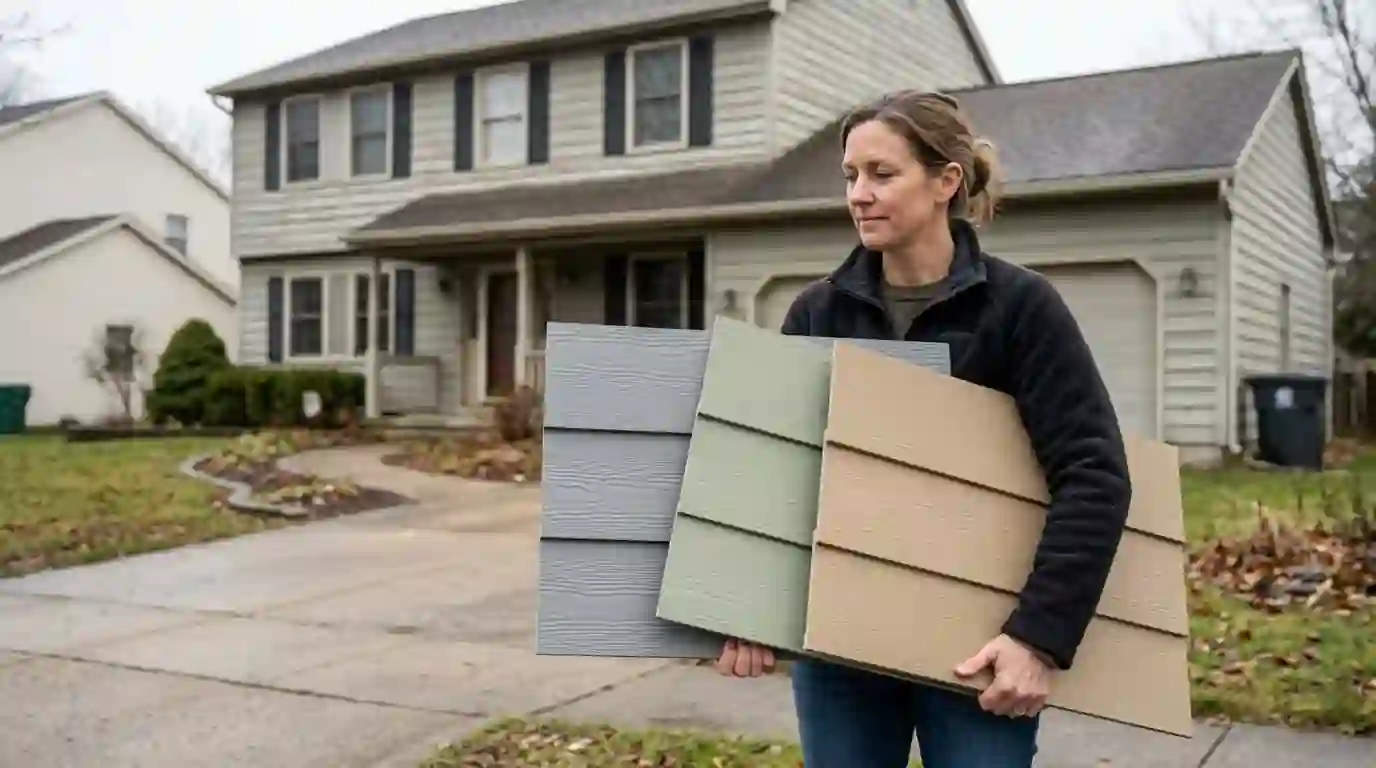
Complete applications move faster than ones that leave the committee guessing. If the house next door is a similar color, say so and explain how yours will differ, since some guidelines limit identical schemes side by side. Large painted samples on the actual siding help you choose before you submit, and a color consultation can put them up for you.
Keep the scheme simple. A body color, a trim color and one accent for the door is the easiest combination for a committee to picture and approve. Unusual choices are not ruled out, but they invite questions, and every question can push your answer to the next meeting.
Townhome rows and shared walls
Attached homes add a layer. Townhouses and other attached units make up 12.2% of Naperville's housing in recent federal survey figures, and in many of those communities the association controls the exterior outright. Siding, trim and garage doors may be repainted on the association's own schedule, building by building, rather than by individual owners.
If you own a townhome, ask whether exterior painting is your job or the association's before you call anyone. If it is yours, the approved scheme is usually fixed, and the work has to match the neighboring units exactly. Matching means confirming the product and formula, not just the color name. We paint HOA and townhome rows to the approved scheme.
Shared walls and shared trim raise practical questions too. Where two units meet, a downspout, a fence or a strip of trim may belong to both owners or to the association. Settle who paints what before work starts, and let the neighbor know the dates so cars, planters and patio furniture are moved on both sides.
Call any time, and we will help you gather the colors, sheens and surface list your committee asks for.
Call (630) 760-2729Timing your request around the painting season
Exterior work around Naperville runs on a short calendar. At O'Hare, spring's final freeze normally lands on April 21 and autumn's first on October 19, and average overnight lows only climb past 40°F in April before slipping to 34.1°F in November. Committees that meet monthly can take a bite out of that window.
That makes winter the best time to apply. Approval in hand by early spring lets you book an exterior repaint for the first good weeks, instead of waiting for a meeting while the season slips. Ask when the committee meets and how long it has to respond under your documents.
Build some slack into the plan. If the committee asks for changes, a second round adds another meeting cycle. Submitting in January or February leaves room for that and still lands the job in spring. The exterior repaint budget guide can help you price the job while you wait.
If the answer is no, or no answer comes
A denial usually comes with a reason: a color outside the palette, a scheme too close to the house next door, or a missing detail. Ask what would be approved, adjust and resubmit. A revised application that answers the stated reason is the quickest path to a yes.
If no answer arrives, follow up in writing and keep copies of everything. Some covenants say what happens when the committee does not respond within a set time, but do not rely on that without reading your own documents. Starting the job without written approval is the one step that reliably causes trouble later.
Once approval arrives, give a copy to your painter and make sure the colors on the job match the approved codes exactly. A store that tints a close match or a substituted product can drift far enough to draw a question. Keep the approval letter, the color codes and a few leftover cans together for the next repaint.
Services this guide relates to
HOA & Townhome Painting
Townhome rows on a set schedule
Exterior House Painting
Scrape, caulk, prime, two coats
Color Consultation
Big samples on your own walls
Garage Door Painting
Steel and wood doors
Sources: nctv17.org, point2homes.com, weather.gov, weather.gov (2), naperville.il.us.